
There are the numbers, of course: tickets sold, long queues, unanimous critical acclaim. Yet what endures longest is often invisible—the questions that are opened, the knowledge gained, the conversations that continue to unfold long after the doors have closed.
This reflection takes shape in the wake of the exhibition that Palazzo Strozzi dedicated to Beato Angelico, an event embraced by an extraordinary audience—nearly 300,000 visitors—and marked by rare enthusiasm. Its success cannot be measured solely in attendance figures, but in the depth and quality of the traces it has left behind.
Art-Test was involved in this exhibition from its very beginning, contributing to the diagnostic campaigns undertaken to investigate in depth the painting techniques of Beato Angelico and other artists. These studies focused on works that had never before been examined scientifically, or only partially so, and supported major conservation interventions. In particular, we worked on the Annunciation of Cortona, the Cortona Triptych, both by Beato Angelico, and on the shaped cross by Pesellino.
These three works demanded an intense and sustained effort, but they offered something invaluable in return: the opportunity to engage in a continuous dialogue with conservators and scholars, to exchange perspectives, and to approach the artwork not merely as an image, but as living matter—complex, stratified, and deeply expressive.
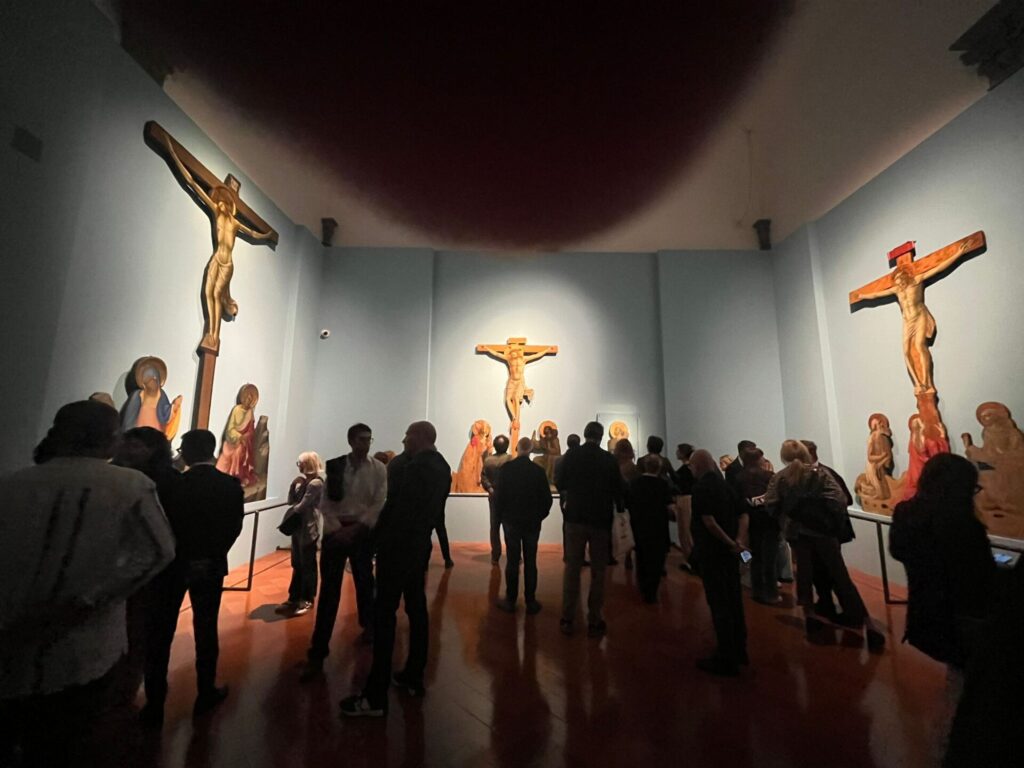
Among the works on display, the shaped crosses—three in total—perhaps left the strongest impression on visitors and are likely to linger longest in collective memory. For us, the encounter with Pesellino’s cross was especially powerful: an artist capable of astonishing through technical refinement and expressive force. Long hidden from view, the work was returned to visibility thanks to the exhibition and to the generous support of the Marchesi Antinori, who sponsored its restoration.
Yet the most profound legacy of the exhibition lies beyond the restored surfaces. It resides in the exchanges that developed around the works. The conservators of the L’Atelier restoration studio involved us from the earliest planning stages, fostering an ongoing dialogue throughout the intervention. Together, we pursued a shared goal: to support conservation while deepening our understanding of the artist’s working methods. In Pesellino, as in Beato Angelico, drawing emerges as a tool of exceptional precision and awareness—even within a brief artistic career.
Throughout all the diagnostic campaigns, our conversations with art historians and scholars proved to be moments of deep human and professional enrichment. As one observer wrote in response to the exhibition images, this was a show that “was needed.”
Perhaps this is what truly remains: the opening of new research paths, restorations conceived specifically for an exhibition, and publications that document not only the event itself but also the investigative processes that made it possible. A quiet yet enduring legacy—one that continues to nourish knowledge long after the exhibition lights have dimmed.


