Often, what we study—both for pleasure and for work—is not well represented in our museums. That’s why we must travel, and beyond major institutions, we also need to explore smaller, local museums.
Driven by the need to see the works and their depicted landscapes in person—and as closely as possible—we embarked on a study tour of Normandy. We visited the Musée des Beaux-Arts in Rouen, as well as the museums in Le Havre, Honfleur, and Giverny. At the same time, we admired the landscapes and vistas of the various Norman cities and villages that the Impressionists once frequented.
In this first episode of our study trip, we want to tell you about the exhibition that Le Havre has dedicated to Claude Monet on the centenary of his death.
Le Havre is, at its core, a true border city: a monumental European port, constantly exposed to the fury of winds and sea currents. Its geographical position was so crucial that it sealed its tragic fate during World War II, when bombings nearly razed it to the ground. Yet today, that same city stands proudly among UNESCO World Heritage sites, an immortal testament to an epic reconstruction entrusted to Auguste Perret, the undisputed “magician” of reinforced concrete. His unique and unmistakable style dominates the entire urban horizon. A dramatic wound masterfully healed: just as in an exceptional painting restoration, the modern intervention blends into the context, remaining clearly distinguishable to the attentive eye, but ultimately restoring harmony, breath, and perfect legibility to the entire local architecture. Right by the seafront, we find the museum: a modern building that fully exploits the light offered by its opening onto the sea.
We will tell you about its permanent collection another time—just know that it is one of the most representative museums for Impressionism, housing not only major names but also key artists in the history of this movement, such as Boudin.
This time, we want to describe the exhibition that Le Havre has organized to celebrate Monet: https://www.muma-lehavre.fr/en/exhibitions/monet-le-havre
The exhibition features approximately 100 works, including oils, pencil drawings, and pastels, as well as family photos. It is a true journey that retraces his life: from the years when he attempted to secure a scholarship with compositions inspired by his masters (because they were more in line with the commission’s taste), to the sketches in his notebooks depicting boats or plant elements; from his skill in caricatures to his first studies on atmospheric aspects, the modulation of light, and the effects of wind on the sea and beaches, all the way to life at the port of Le Havre. There are also portraits of his family and, finally, the three paintings that Monet gifted to the city to which he owed his Impressionist inspiration.
Parallel to this, and for the most curious, it is possible to observe the evolution of his signature, not only in form but also in substance. Initially, Monet signed his works as O.M., using his first name: Oscar. Only later did he begin to use the name Claude, first as C.M. and gradually shifting to his full first and last name.
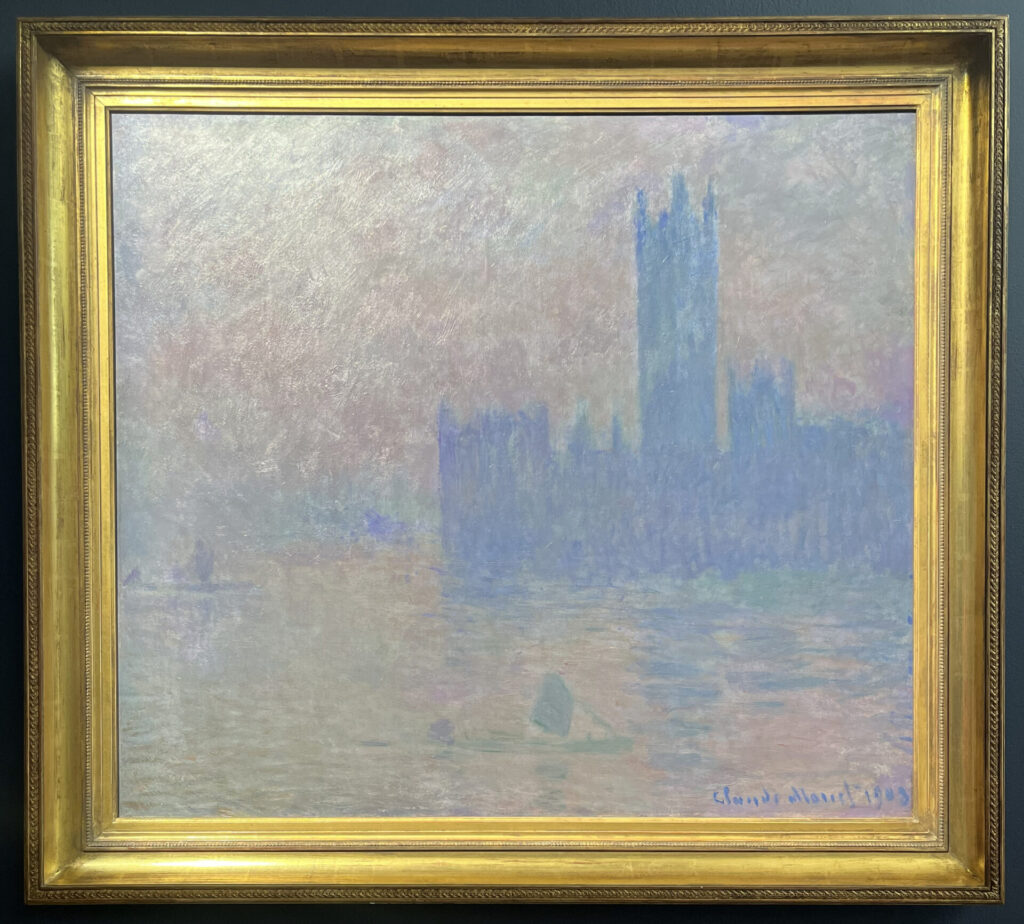
There are many paintings that caught our attention—we show them to you in the attached photos—but one in particular stood out, not for its subject or stylistic importance, but for its caption. It states that the painting was recently restored for the exhibition, and although it was originally created without varnish—a technical choice shared by many Impressionists—during the restoration, it was decided to apply varnish to make the colors more saturated.
Forgive us for this reflection: why? Why not adhere to the original technical choice? Does the historical instance succumb to the aesthetic one? In this case, we would have preferred to experience the work as it was originally created.
Studying a painter’s technique in depth and knowing it thoroughly means being able to distinguish between those who were inspired by it for stylistic exercise and those who did so with fraudulent intent, as opposed to an original. An Impressionist painting today can be worth millions of euros, which is why the market is flooded with fakes.
The exhibition in Le Havre is beautiful in its representation of Monet as an artist. Unfortunately, the catalog is not at all up to the same standard. An exhibition of this caliber would have been a splendid opportunity to analyze the paintings and study the evolution of technique through diagnostic investigations such as reflectography and radiography, as well as to explore the evolution of the pictorial palette. Chemical analysis of the pastels would have been appropriate—this medium is still not sufficiently studied, with few databases and little information available in the literature.
Particular attention should also have been given to the evolution of the signature, not only as a graphic trait but also as a stylistic choice. When did he sign? On a dry layer of paint, or did the color of the signature blend with the fresh paint layer of the painting, thus mixing the colors and creating non-replicable streaks unless one is familiar with his technique?
The exhibition will remain open until September 27. A visit is highly recommended.