How a Fake Medieval Illustration hid The Lost Genius of Archimedes
The Archimedes Palimpsest is one of the most extraordinary books in human history. But if we can read it today, it is only thanks to a test conducted with ultraviolet light.
We are talking about the oldest surviving manuscript of Archimedes’ works, which represents the most significant evidence of the genius from Syracuse, born there around 287 BCE.
It had been lost, erased, and overwritten to the point of becoming unrecognizable.
Recently, one of its pages was rediscovered, where writings and diagrams re-emerged beneath a fake medieval illustration that had been painted over the original text, presumably around 1942, in a clumsy attempt to increase its market value.
But let’s start from the beginning, because the story of this manuscript is truly incredible.
As everyone knows, Archimedes was the most famous mathematician, physicist, engineer, astronomer, and inventor of antiquity. Among other things, he anticipated modern calculus and mathematical analysis by applying concepts such as infinitesimals, the calculation of pi, and the method of exhaustion to derive and rigorously prove numerous geometric theorems.
Unlike his inventions, however, Archimedes’ mathematical writings were little known in antiquity.
It is believed that the first complete compilation of his works was only created around 530 CE by Isidore of Miletus in Byzantine Constantinople. Constantinople was, after all, the only place where the tradition of copying and preserving ancient texts had remained uninterrupted from antiquity through the Middle Ages.
The Archimedes Palimpsest that has survived to this day is a 10th-century Byzantine manuscript containing Archimedes’ works, including texts once thought to be lost forever.
Archimedes’ writings were translated into Arabic in the 9th century and then into Latin in the 12th century, becoming a milestone—an essential source of inspiration for scientists during the Renaissance and the Scientific Revolution.
At the time, Constantinople was the richest city in Europe and, for over 700 years, had been a safe haven for ancient texts. However, in the years following the sack of Constantinople, there was little demand for Archimedes’ advanced mathematical treatises.
The first truly unfortunate event for the Palimpsest occurred in the 13th century, when parchment had become expensive and sought-after. A monk, probably, scraped away much of the original text, cut the pages apart, rotated them, and reused them to create a prayer book.
And so, for centuries, no one realized what was hidden beneath.
We don’t know how the manuscript ended up in Jerusalem, where the biblical scholar Constantine Tischendorf came across it and realized it contained some mathematical texts.
Nor do we know how the Palimpsest left the Holy City, but on October 28, 1998, it was auctioned by Christie’s in New York, presented as coming from a private French collection.
The day before, the Greek government and the Greek patriarch filed an injunction against Christie’s in an attempt to block the sale, arguing that the book had been stolen.
However, here is the second truly unfortunate event: the injunction failed, and the sale went ahead. The court records of the injunction and subsequent proceedings show that the manuscript had been in the French collection at least since the 1960s, and the family claimed it had belonged to them since the 1920s. There was nothing to be done.
The fact remains that, during these wanderings, the book had suffered greatly, and some pages had been lost.
However, the new owner allowed it to be deposited at the Walters Art Museum in Baltimore, United States, where it is still preserved and was made available for study.
It was only in 2002 that Professor Lowden of the Courtauld Institute attempted to investigate it using ultraviolet light to visualize traces of what had been erased. He successfully managed to read and decipher a phrase at the bottom of folio 1 verso of the manuscript, which bears the date April 13, 1229—likely the date the manuscript was completed.
Following this discovery, further multispectral analyses were planned, which revealed other fundamental parts of Archimedes’ text.
Now, the truly fortunate and completely independent event: the Musée des Beaux-Arts in Blois had preserved a page of a manuscript with a fake illustration, without knowing much about it—certainly without suspecting it was connected to the Archimedes Palimpsest.
However, thanks to a researcher from the CNRS at the Centre Léon Robin for Research on Ancient Thought (CNRS/Sorbonne University), the Blois page was analyzed and revealed to be an exceptional discovery: it was one of the missing pages of the Palimpsest.
On one of its two sides, there is currently a prayer text beneath which geometric diagrams and a passage from the treatise On the Sphere and the Cylinder, Book I, Propositions 39–41, have been legible.
The other side is still covered by the fake miniature, depicting the Prophet Daniel surrounded by two lions, beneath which the ancient text remains inaccessible using conventional examination methods. However, science has advanced since the early 2000s, so now there are plans not only to investigate the recovered page with other methodologies but also to re-examine the entire Archimedes Palimpsest using more powerful techniques than those employed in the first campaign, with the goal of obtaining a new reading of the pages that remained illegible during the initial effort.
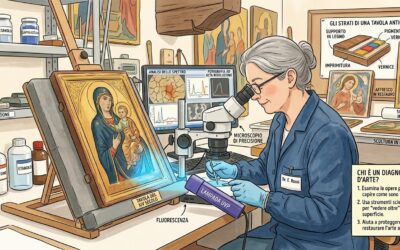
Art-Test offers several of these imaging techniques to help uncover hidden details. Whether it’s one of the other missing pages or any other object, hidden and revealing details are more common than you might think—as many of our clients have discovered.