Did he really produce fake Picasso, Braque, De Chirico ?
The scandal of Magritte consciously producing intentional forgeries of other authors, such as Picasso, Braque, and De Chirico, began in 1988 when his former friend (and later enemy) Marcel Mariën published his autobiography titled “Le Radeau de la mémoire” in which he writes that Magritte was not the upstanding person everyone believed him to be, because “Magritte behaved in a very unusual way many times: making fake Picassos, Braques, and De Chiricos. Moreover, producing (with his brother who printed the banknotes) counterfeit money. Indeed, in everyday life, he did not behave at all like a bourgeois, he played many pranks. It is too big a thing to describe…” Mariën’s statement, which on the other hand claims he was tasked with placing those fakes on the market, clearly sparked a major debate that I dare say has helped to understand much better the work of the great Belgian surrealist.
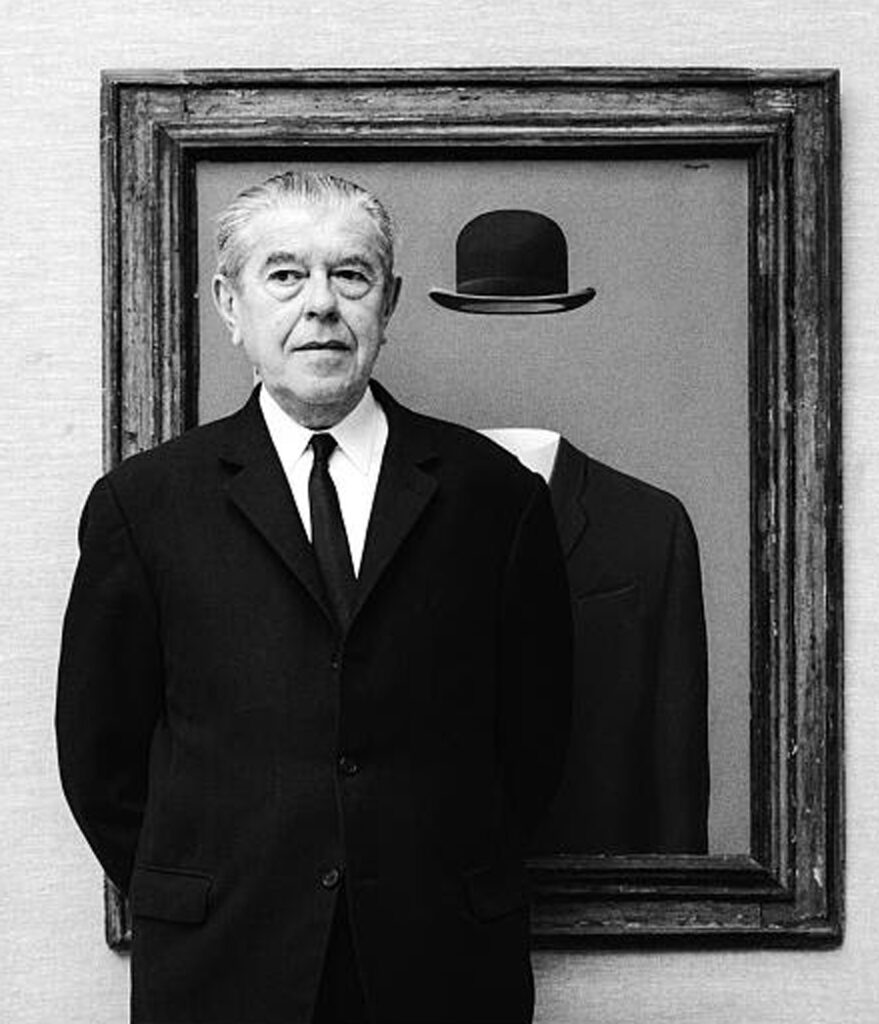
Indeed, these alleged forgeries by Magritte (alleged because there is no certain and indisputable proof that the news given by Mariën corresponds to the truth) can still be read as subversive strategies he deployed against his own official work, which he simultaneously builds and demolishes, placing the viewer in eternal uncertainty. And on the other hand, forgery and plagiarism are often considered central themes in Surrealism.
Taking a step back, it was Marcel Mariën himself who wrote the introductory essay of the first monograph on the art of René Magritte, titled “Magritte”, published in 1943, during World War II, while Belgium was occupied by the Germans. The painter personally chose 20 images for the book which were reproduced in color, a choice not taken for granted given the higher costs and Magritte’s not yet established economic position. Moreover, it is worth remembering that Magritte selected a very particular group of his works, rather eccentric compared to those more universally known, to the point that out of 20 plates, 10 reproduced his works from the “impressionist” period, works that show us how for Magritte art is not the solitary product of a creative individual, but a collective invention made of plagiarism and collaboration with other works of art. And it is precisely in relation to the high expenses for this first monograph on the artist that Marcel Mariën in his 1988 autobiography makes those statements about the forgeries we mentioned. According to Mariën, Magritte would have produced and sold artistic forgeries between 1942 and 1946, and it is for this activity that Magritte would have had a very “relaxed” attitude, stating that “buying a fake diamond without knowing it will cause the same degree of satisfaction [as buying a real one], because of the fact that a high price was paid for it.”
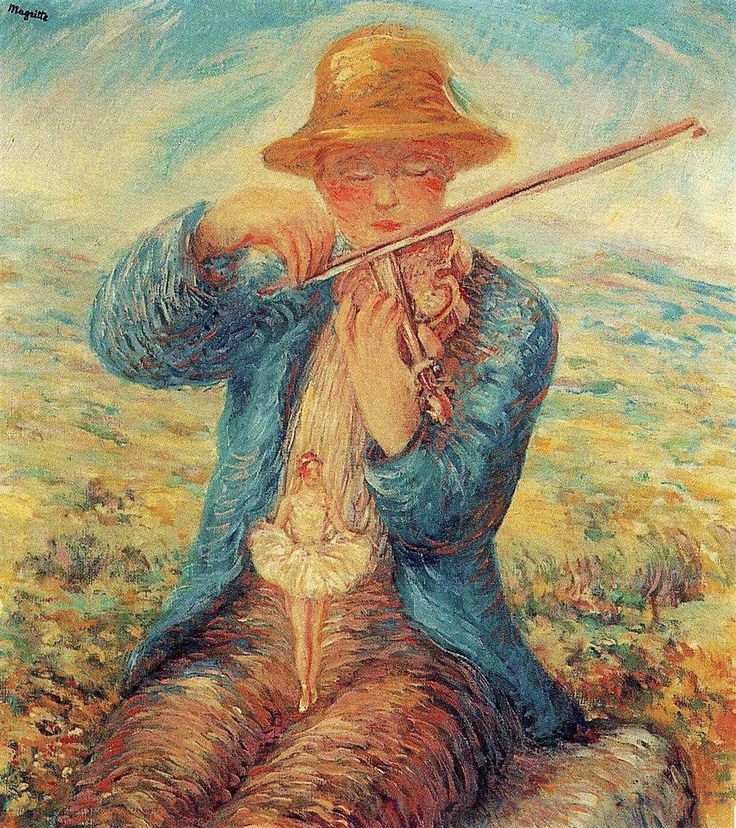
In reality, more recent criticism has read Magritte’s alleged forgeries in close connection with the central body of his “authentic” works. Indeed, these fakes can be read as part of a fundamental and very broad reflection throughout the artist’s career, on the issues of paternity, authenticity, and ultimately, with his declared subversion and denunciation of the falsehoods of capitalist ideologies and realities. Indeed, Marcel Mariën himself states in that first monograph of 1943 that: “The particular point of [Magritte’s] painting… is a permanent revolt against the clichés of existence.”
So, Magritte’s forgeries could be part of a broader method by the artist aimed at disrupting the “thought habits” of Western bourgeois capitalism. Hence, these apparently “marginal” works continuously threaten to destroy the “coherence” of the author’s established work and of his very authorship. Magritte’s alleged forgeries, like his different periods often ignored by criticism, (such as what he calls the Vache or Cow period, i.e., works parodying fauvism, and the impressionist period of the 1940s), are elements from which emerges a much more interesting Magritte, in our view.
The supposed fakes by Magritte then could be part of a “counter-work” in opposition to the official and “historical-artistic” Magritte, which subverts and undermines any simple synthesis of Magritte as a coherent and self-consistent artist. Indeed, this notion of “absolute uncertainty” is something that allows us to understand an important aspect of Magritte’s images: the betrayal of the viewer, who is induced to confuse and therefore to misinterpret one thing for another, the negation, the “ceci n’est pas” and uncertainty are central in his art that denies Western notions of authenticity, originality, and genuine meaning of the artwork.
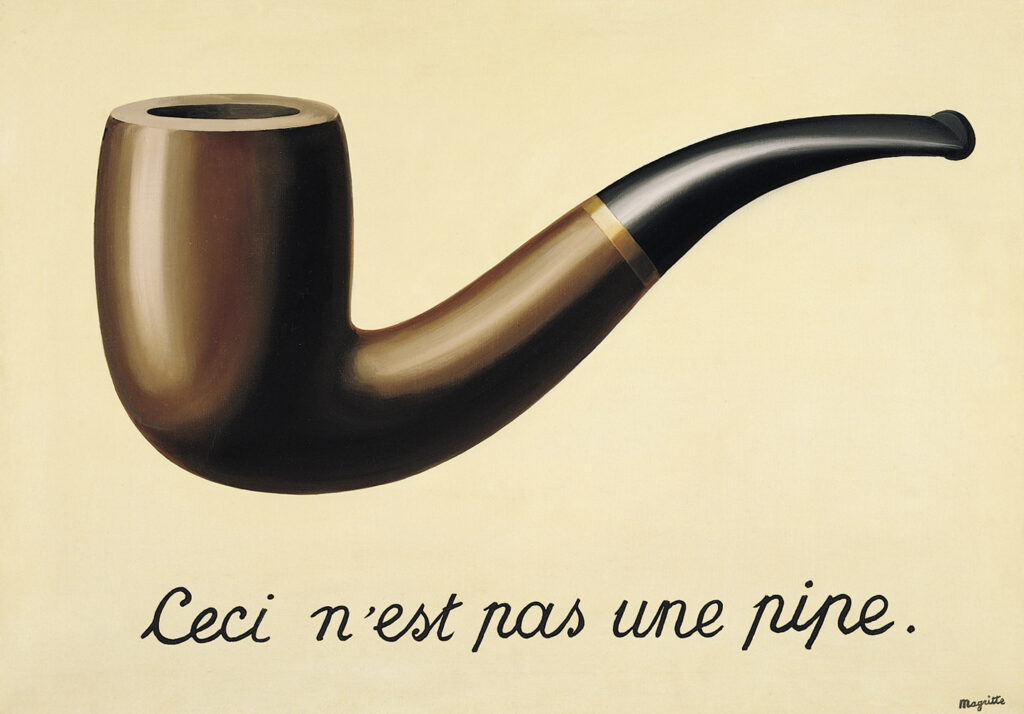
It is no coincidence that one of his most famous works is precisely “La Trahison des Images” (1928), in which betrayal is already present in the title, but most importantly, this work brings forth a new hierarchy between text and image that is immediately destabilized, since the image contains the text and the text contains the image, leading to the impossibility of providing an answer to what this image is. Moreover, the phrase “Ceci n’est pas” directly refers to the specificity of forgery.
But suppose one of these forgeries arrives at the Art-Test laboratory, how could we distinguish a fake Picasso produced by Magritte from an authentic Picasso? It’s not so easy, because the artists were contemporaries and therefore had access to the same materials. It’s the analysis of the execution technique that could demonstrate a different hand, namely what the artist does to create a painting and what then remains hidden under the last layers of color.
And how much could a fake Picasso made by Magritte be worth on the market now? After all, it’s true that there are no fake paintings, but only misattributed ones.