During the explosion in Beirut on 4 August 2020, which caused 207 deaths and approximately 7,000 injuries, and which irreparably destroyed part of the Lebanese capital, the losses to assets were also considerable. Making an inventory of them has also brought to light two paintings until recently without attribution.
The Lebanese art historian Gregory Buckhakjian is convinced that the artworks recovered were created by the hand of Artemisia Gentileschi. And Buckhakjian knows very well the history of the Sursock Palace collection, the building where the paintings were located – and which was heavily damaged during the attack -, as in 1993, he discussed his doctoral thesis at the Sorbonne University, precisely on this topic.
It is known that the works arrived in Lebanon in 1920, with the collecting nucleus of Alfred Sursock, husband of Maria Teresa Serra di Cassano, Neapolitan, daughter of Francesco Serra, seventh Duke of Cassano. The collection consisted of works by various Neapolitan artists of the seventeenth century, such as Luca Giordano and Andrea Vaccaro, but also Matthias Stomer. Artists already known and valued. There were also two paintings of unclear attribution. The hand of the painter was not among the best known.
The idea of them being by Artemisia came to the scholar right during his studies. At the time, he told Hyperallergic magazine, “it was still a student job. When I discussed my thesis, my teachers told me it was very convincing and that I should continue my research and publish it. But I didn’t, because at the time, after I returned to Beirut, I was completely shocked by what was happening in the city and I forgot about Artemisia [the Lebanese civil war had just ended, ed]. My priorities concerned the city, reconstruction, etc. ”.
His studies were shelved until last year, when the two paintings were found among the ruins of the palace. The works are: a Hercules and Onfale, dating back, according to Buckhakjian, to the early thirties of the seventeenth century, and a Penitent Magdalene from around 1640. Making a comparison with other paintings, attributed with certainty to the artist, the historian focused on some details that make Artemisia’s works recognizable, such as drapery, jewels and more, and found many similarities.

Ercole e Onfale by Artemisia Gentileschi, damaged by the explosion
The current attention for these works is also linked to the interest in the artist, linked to that for women painters which has finally seen a strong increase in recent years.
Although, to tell the truth, Artemisia’s name is perhaps mostly known for the gruesome story of her rape and the torture trial that ensued.
A series of events we would never want to hear about again.
The Penitent Magdalene was loaned to the exhibition The Ladies of Art in Milan (Palazzo Reale), the attribution was confirmed by Riccardo Lattuada (specialized in Artemisia Gentileschi). The scholar, Sheila Barker also confirmed the attribution, recognizing the details and traits that distinguish the artist’s hand.

To date, the two paintings are still unpublished: in all probability Buckhakjian will publish some studies on the subject soon.
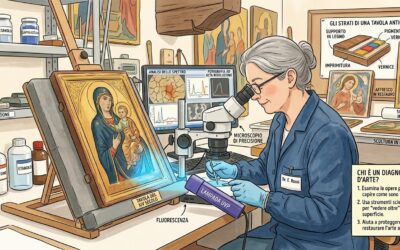
As the two works will almost certainly undergo a restoration, given the damage suffered during the explosion (La Maddalena exhibited in Palazzo Reale still shows the signs), we hope that a diagnostic campaign will also be carried out, which would help knowledge of the technique of this extraordinary painter who, despite recent glories, is still largely unknown.
And a scientific attribution of these, as of all works, can no longer ignore a comparisons of this type as well.