A New AI Model to Distinguish the Master’s Hand from That of TheirPupils
For years, art historians have debated the attribution of The Baptism of Christ: how much of it was painted by the master’s own hand, and how much was done by the workshop, assistants, or later interventions? The question is far from trivial, as it can dramatically affect the value of the work. How often have we heard the weaker parts of a painting justified as “finished by a pupil”?
El Greco, born Domenikos Theotokópoulos (1541–1614), began his career as an icon painter in Crete before traveling through Venice and Rome, eventually settling permanently in Toledo, Spain. It was there that he blended Byzantine and Venetian motifs and developed his distinctive style—loved or hated—characterized by distorted human figures and the use of pure colors in sometimes dissonant combinations. Take, for example, The Baptism of Christ (1624, Hospital Tavera, Toledo, Spain).
Art historians have long considered The Baptism to be a work involving both El Greco and at least one other artist. Historical evidence indicates that El Greco began the painting under a commission from Hospital Tavera but kept it with him until his death in 1614. It was delivered to the hospital nearly a decade later, a period during which it is believed the painting was completed by workshop members, particularly the master’s son, Jorge Manuel.
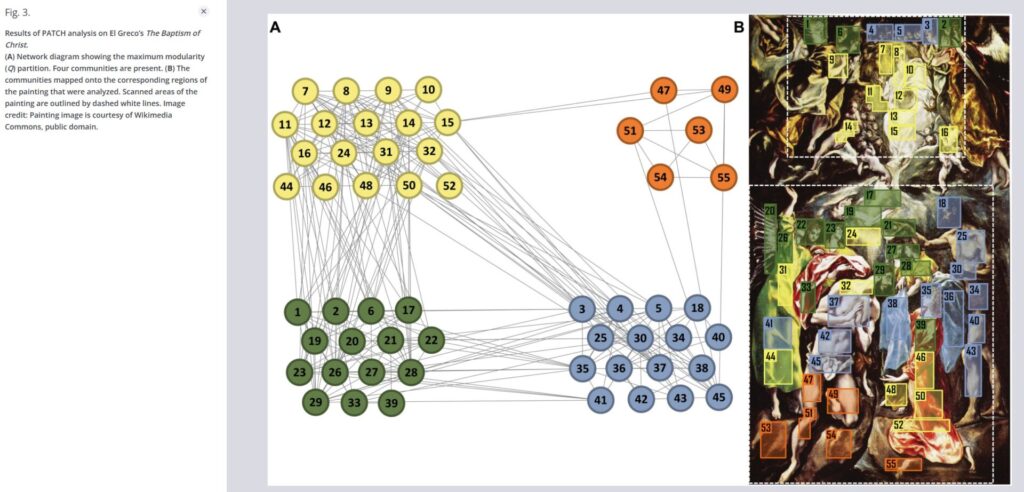
It has been suggested that El Greco personally painted the entire upper part, with the possible exception of the robe of the angel on the right and the green angel (bottom left), excluding the wings. Jorge Manuel, on the other hand, is credited with the figure of John the Baptist (bottom right) and the adjacent figure in red. Renowned scholars Lopera and Wethey attribute the image of Christ (bottom center) to Jorge Manuel and El Greco, respectively. In short, there is no substantial consensus.
To test their AI- and neural network-based painting analysis method, a team of researchers from Case Western Reserve University and Purdue University decided to analyze this very controversial work.
The new technology, called PATCH, is an analysis system based on artificial intelligence and 3D microscopic scans of brushstrokes. The study was published in the scientific journal Science Advances, part of the Science group.
In recent years, several AI-based attribution systems have emerged, such as those proposed by the Swiss company Art Recognition, which have made headlines—and sparked controversy. These software tools attempt to identify an artist’s stylistic “signature” by comparing the work in question with large image databases.
The problem is that, for ancient paintings, such large databases do not exist.
Large statistical models require enormous amounts of data to be reliable. However, in the case of old masters, the number of works definitively attributed to their own hand is small, and even fewer are those certainly attributed to pupils or workshops. Moreover, almost all ancient paintings have undergone restorations, cleanings, overpaintings, or abrasions that alter the very surface elements the algorithms rely on.
The PATCH project, however, takes a completely different approach.
Instead of comparing the painting with thousands of other images, it studies microscopic variations in the painted surface to determine whether different areas were created by the same hand or by different ones.
This approach is much closer to traditional scientific diagnostics: X-rays, infrared reflectography, and stratigraphic analysis are not only used to expose forgeries but, above all, to enter the artist’s studio, tracing rethinks, corrections, workshop interventions, and transformations over time.
In the case of El Greco’s painting, the PATCH analysis revealed a surprising technical continuity across the various areas of the work, suggesting a much more extensive direct involvement of the master than some scholars had believed.
Thus, the AI’s verdict contradicts that of the art historians: the work appears to be entirely by El Greco’s hand.
AI may not yet be able to reveal the absolute truth, but it is certainly shifting the focus from attributions based on the experts’ eye, provenance, and stylistic comparison—primarily answering “who painted it?”—to seeking scientific answers to the question, “how was this painting truly created?” This is the approach that Art-Test has always adopted. The idea is not to replace art historians but to help examine the work from different perspectives.
Perhaps the most surprising aspect of this research is that, unlike most technologies, PATCH was not developed for health science or industry and then adapted for art. The opposite happened: PATCH was created to study paintings, and only later was it considered for application in other fields, from medical diagnostics to industrial quality control. And if it works on art, it is likely to achieve excellent results in other areas, because—contrary to popular belief—applying it to paintings is far more challenging. After all, every painting is truly unique, with no common physical structure to reference to!