Three months have now passed since the Ministry of Culture announced the acquisition—from a private owner—of Caravaggio’s Portrait of Monsignor Maffeo Barberini, a work that has since entered the Italian State’s heritage and joined the collections of the National Gallery of Ancient Art at Palazzo Barberini in Rome. Everyone knows the cost of this acquisition was €30 million.
This news made headlines worldwide. In the realm of Old Master art, Caravaggio is one of the very few names capable of drawing crowds: any exhibition that somehow includes the Bergamasque artist’s name in its title is virtually guaranteed public success. Yet this particular story has resonated for several reasons: the work’s own history (it only resurfaced in 2024, 60 years after its initial publication), and the fact that it is a portrait—a genre in which only three works by Caravaggio are currently recognized.
The painting was first published by Roberto Longhi in 1963, in an article for his journal Paragone titled “The True ‘Maffeo Barberini’ by Caravaggio.” Since then, scholarship has harbored virtually no doubts about its authorship. Longhi himself highlighted that this portrait represented a pivotal moment in modern portraiture, emphasizing how Caravaggio had succeeded in introducing a new psychological intensity into the representation of his subject—capturing the living presence of the sitter without resorting to rhetorical or celebratory devices.
The corpus of works universally attributed to Caravaggio is relatively small—no more than about 65 paintings survive worldwide. Portraits, however, are particularly rare: most scholars recognize only two other authenticated examples by the artist—the Portrait of a Knight of Malta (Palatina Gallery, Florence) and the Portrait of Alof de Wignacourt (Louvre). Thus, the Portrait of Monsignor Maffeo Barberini stands as a fundamental testament to this genre in Caravaggio’s oeuvre. It also offers a crucial contribution to understanding the evolution of his pictorial language between the late 16th and early 17th centuries, as the work is dated to c. 1599 or 1603.
The fact that this painting was endorsed by Roberto Longhi—the greatest Caravaggio expert of all time—may have influenced its near-universal acceptance among scholars, both past and present. (Recent reports suggest it was actually Longhi’s student, Giuliano Briganti, who first discovered the work, though he deferred the honor of publication to his master.) Yet here lies the anomaly: a €30 million painting was acquired without any supporting diagnostic campaign—at least, none has been disclosed in official communications. This is no minor detail, as technology in this field is an indispensable tool for establishing authorship, identifying repainting, analyzing materials, and determining chronology.
Amid the flood of articles, press releases, and television segments—often featuring the Minister front and center—another anomaly emerges: almost no one has mentioned the existence of a second portrait of Maffeo Barberini, one that has been extensively analyzed, including from a scientific standpoint.
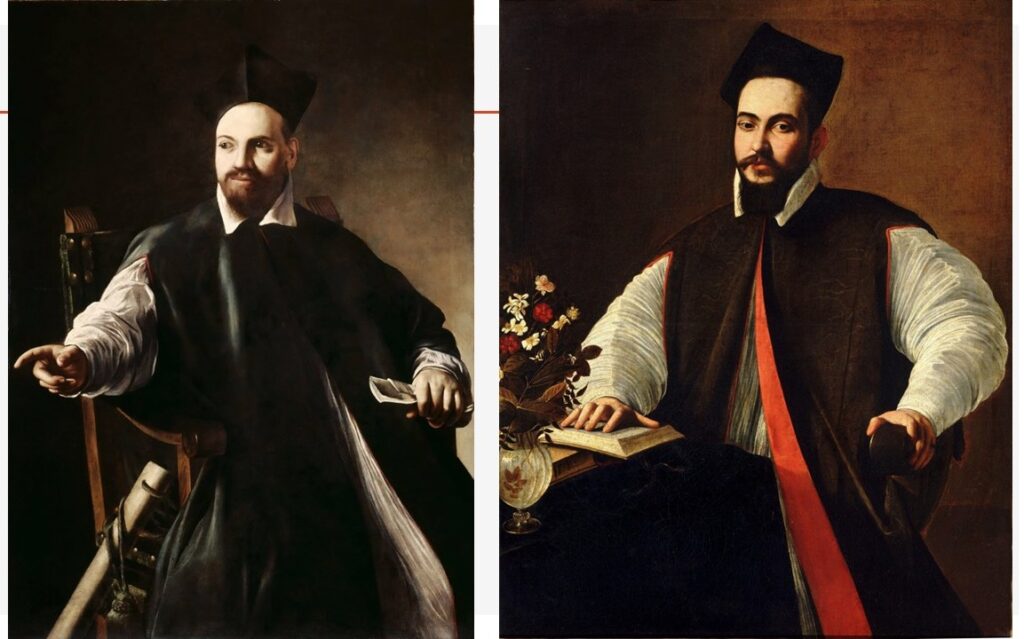
This second portrait, preserved at the Galleria Corsini in Rome, has a history that mirrors the first. It was initially published in 1912 by Lionello Venturi as a work by Caravaggio, gaining significant support. Yet in his 1963 article (provocatively titled “The True ‘Maffeo Barberini’ by Caravaggio” in direct response to the Corsini version), Roberto Longhi rejected its authorship, attributing it instead to a follower of Scipione Pulzone—an artist he deemed both mediocre and improbable. Longhi’s authoritative dismissal effectively stifled further debate. However, the attribution has recently been revisited with vigor, thanks to in-depth analyses conducted for the 2010 exhibition Caravaggio and the Caravaggisti at Palazzo Pitti in Florence. On that occasion, Gianni Papi (curator of the Florentine exhibition) and Keith Christiansen (Metropolitan Museum of Art) reaffirmed the work’s attribution to Caravaggio, dating it to c. 1596–97.
A preliminary UV fluorescence examination of the Corsini painting revealed numerous small, altered retouchings that, while skillfully masking abrasions in the original paint, simultaneously compromised the overall legibility of the image.
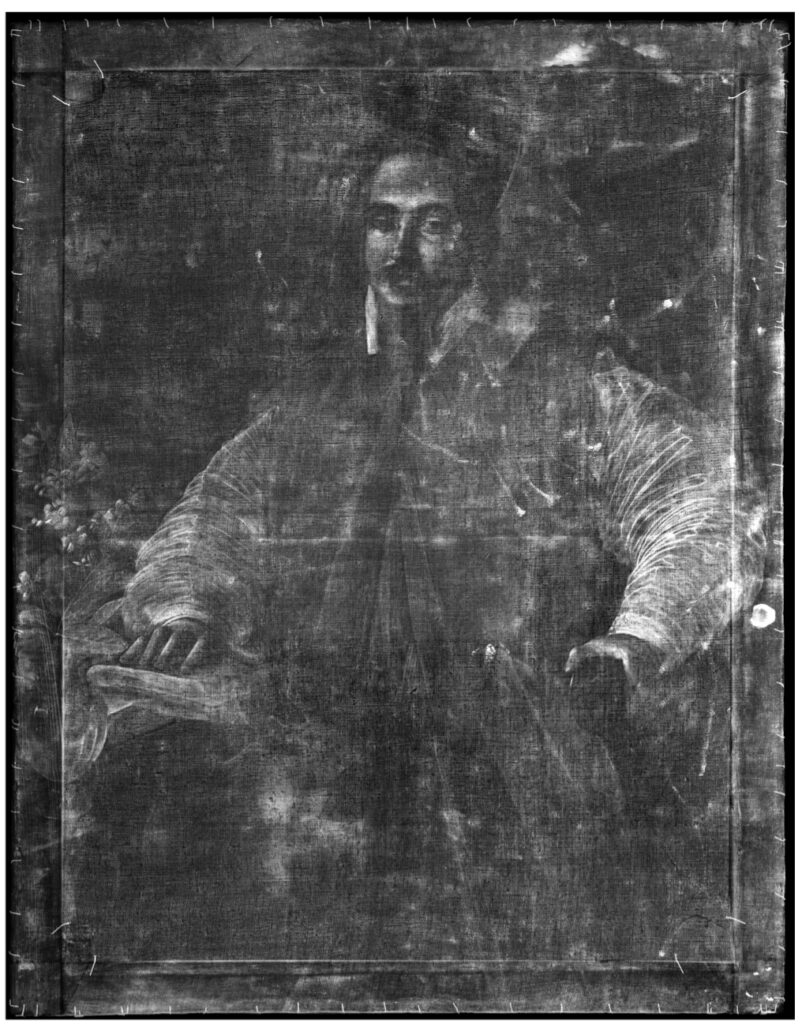
Radiographic image from Kermes no. 78, “The Portrait of Maffeo Barberini: Technique, Restoration, and Attribution to Caravaggio”
Through comprehensive analysis of the painting’s constituent elements—the support, preparatory layers, and paint application—restorers gained profound insight into the artist’s modus operandi. They employed macro and microphotography, rake light and UV fluorescence imaging, infrared reflectography, and false-color infrared. The radiographic campaign covered the entire painting, while XRF (X-ray fluorescence) and FORS (fiber-optic reflectance spectroscopy) were applied to selected areas. To complete the non-invasive investigations, micro-samples were also taken for stratigraphic analysis.
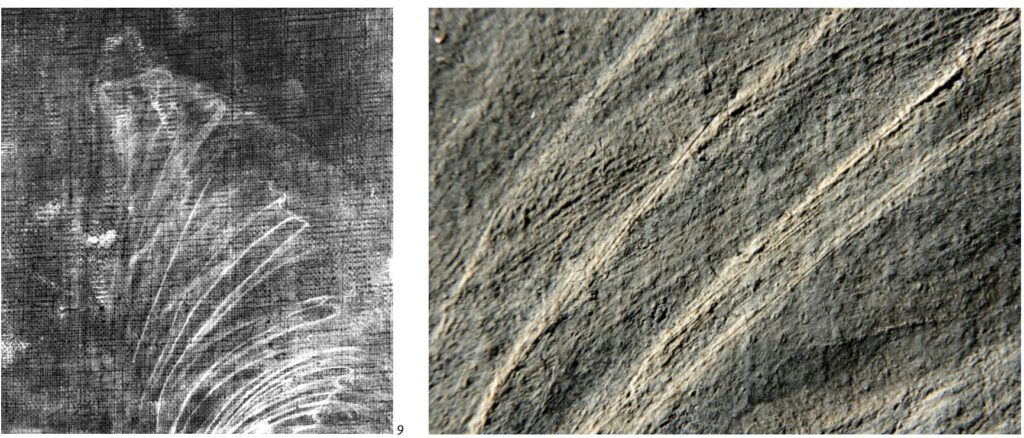
Details of the radiograph and rake light image of the sleeve (from Kermes no. 78), showing the incisions.
This extensive analytical program identified executive features long considered Caravaggio’s veritable “signatures.” Two types of freehand incisions were detected:
- Rounded-point incisions (possibly made with the brush handle itself), used to schematically outline key compositional lines. These irregular marks—created by pressing rather than scratching—appear to the left of the face, at the central fold of the black biretta, and along the curves of the sleeve and the red lining of the cloak.
- Sharp-point incisions (made with a stylus or awl), which scratched the preparatory layer. More numerous and seemingly added later, these were not used for contours but as guides for painting, marking the highlights of fabric folds (visible near the left arm) to indicate the movement of the cloth.
This dual incision method—executed freehand with two different tools—has been documented repeatedly in Caravaggio’s works. For many scholars, it is an unequivocal sign of his authorship, as he almost always painted from life and directly from the model.
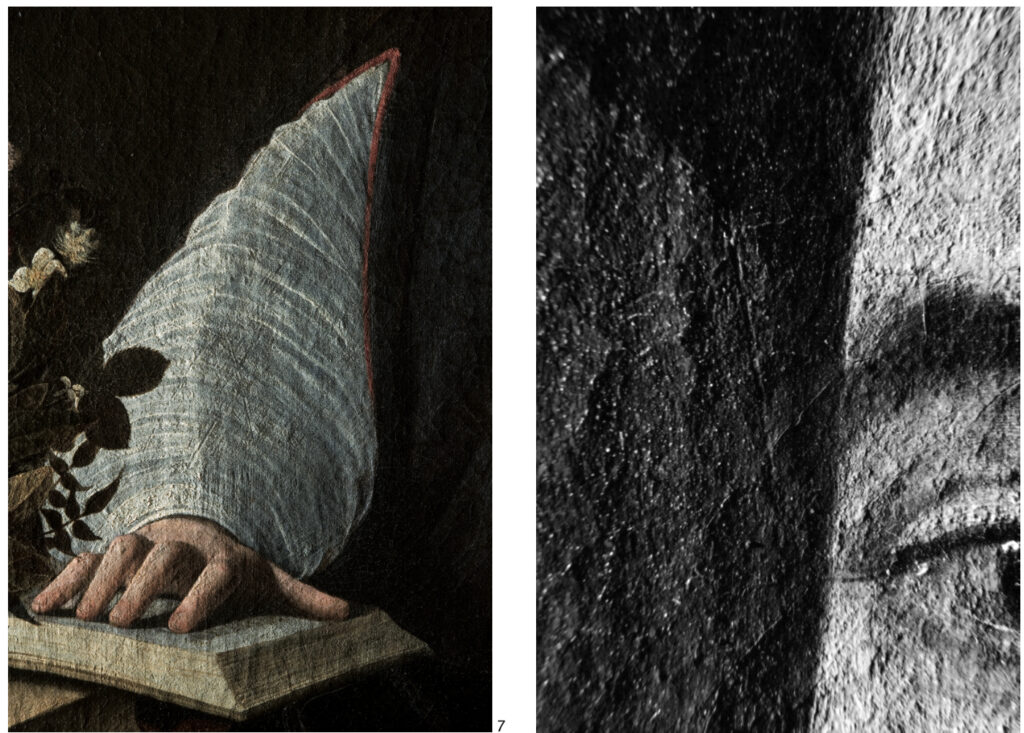
Thanks to the restoration, further observations strongly support Caravaggio’s paternity of the Corsini portrait. The subtle gradations of gray and black modeling the play of light and shadow on the sleeves are typical of his hand, as is his practice of revisiting the canvas with rapid, long brushstrokes to define the folds of the white linen rochet across the abdomen. Despite minor pentimenti, the radiographs reveal a confidence and clarity in the underdrawing directly comparable to that seen in the Bacchus (Uffizi), a work of similar date.
In summary: two masterpieces of late 16th-/early 17th-century portraiture, both attributed to the same master—Caravaggio. Yet one attribution rests solely on stylistic and documentary grounds, while the other, though also grounded in archival and stylistic evidence, is further supported by scientific data.
Two profoundly different approaches to the study of art history.