Bought as a workshop piece, then restored and studied, is now on display at the Kimbell Museum in Texas
A few months ago, we reported the rediscovery of a masterpiece by Artemisia Gentileschi, thought to be lost but happily found (here’s the article). It was a Penitent Magdalene, a theme much loved by the painter, which the Robilant+Voena gallery in New York presented at the “Ahead of Her Time: Pioneering Women from the Renaissance to the Twentieth Century” exhibition in February 2024.
Now, an important museum in Texas, the Kimbell Art Museum in Fort Worth, has recently acquired another significant painting by Artemisia, again a Penitent Magdalene. This particular composition, with the saint appearing to sleep or meditate, resting her head on her right hand, was known through several copies. Until now, some believed that the original had been lost.

The news from Fort Worth has drawn attention not only from scholars but also from the general public, as the figure of Gentileschi, neglected for centuries, is now well-known even to non-specialists. She is increasingly sought after to enrich museum collections, which are rightly aiming to highlight the works of female painters.
The painting was created around 1625-1626 and remained in private hands from the time of its execution until today. At the Kimbell Art Museum, the painting has been on display since September 5, in the section showcasing other significant masterpieces of early 17th-century Italian painting, including The Cardsharps by Caravaggio (circa 1595) and Christ and the Samaritan Woman by Guercino (1619-1620).
The early history of the painting is relatively well-documented: it was purchased, and perhaps even commissioned, by Fernando Enríquez Afán de Ribera, third Duke of Alcalá and Viceroy of Naples. He began his career as a diplomat, becoming the Spanish ambassador to the Holy See in 1625-26, and later served as general vicar in Italy during the papacy of Urban VIII Barberini. His career advanced further as he was appointed Viceroy of Catalonia, Naples, Sicily, and eventually Governor of the Duchy of Milan. Known for his passion for art and literature, he was a patron of many artists, especially Jusepe de Ribera. The numerous works he acquired over the years were regularly sent to his home in Seville. At least two 18th-century sources describe the Duke as a patron of Artemisia during his years as an ambassador in Rome, and in the inventories of his collection, there’s a work described as “Una Mag.na sentada en una silla durmiendo sobre el braço de Artemissa Gentileça romana” (“A Magdalene sitting in a chair sleeping on her arm, by Artemisia Gentileschi of Rome”). This description perfectly matches our painting.
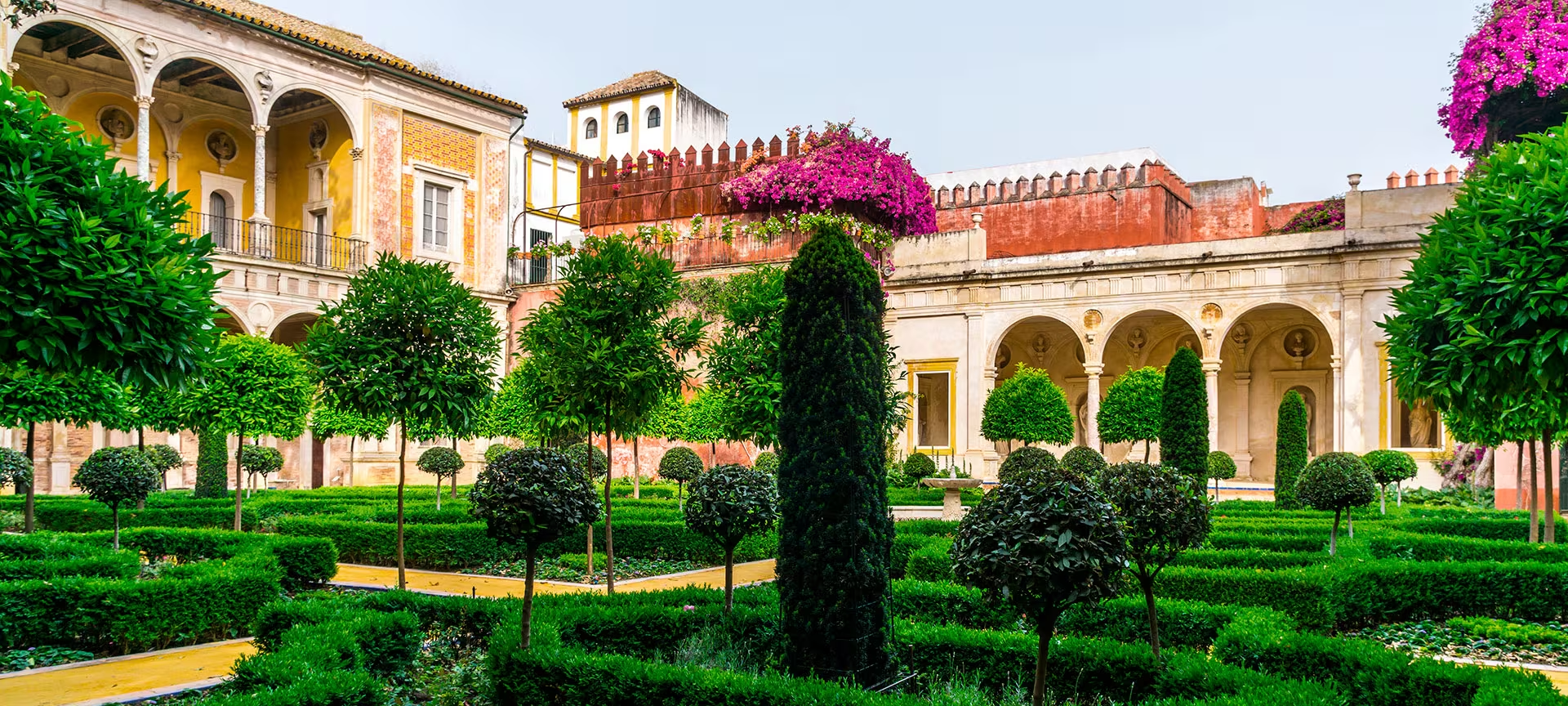
The painting, like other works owned by Fernando Enríquez Afán de Ribera, was displayed in his famous residence, the beautiful Casa de Pilatos in Seville, where, according to other 17th-century Spanish sources, the piece became famous and was frequently copied.
One of the most famous copies of this composition, by some believed to be the original, which over the centuries has perpetuated Gentileschi’s work, is housed in Seville Cathedral, and has long served as the primary reference for this lost painting. In later centuries, after remaining in the hands of the Duke of Alcalá’s heirs, the painting disappeared, only to resurface at a French auction house, Tajan, in 2001. However, it was presented as a workshop piece by Artemisia Gentileschi. A private collector purchased it, and it remained in private hands until 2024 when the Kimbell Museum acquired it through an intermediary company.
Artemisia Gentileschi explored the theme of the Penitent Magdalene throughout her career, a subject previously depicted multiple times by Caravaggio with his dramatic contrasts of light and shadow and the use of live models. Her exploration of various key moments in the narrative of the saint demonstrates Artemisia’s extraordinary ability to express the spirituality of the character through the intense physicality of the female figure.
In the Kimbell painting, Magdalene sits in a decorated chair with a high back. Her entire body reveals a state of total abandonment and deep meditation on her life: her right arm rests on the armrest to support her tilted head, casting a deep shadow beneath her neck and chin; her right hand is limp, sharply bent. Her left arm droops downward, with her hand resting in her lap. In the shadow on the left, a jar of ointment and a small black-framed mirror lie on a table. These objects, along with her precious bracelet and large pearl earring, identify her as the penitent saint renouncing her former life of luxury and vanity.
The composition is brought to life by a delicate play of light and shadow, captured by Artemisia’s painterly skill, which describes the texture of the flesh, hair, and fabrics of Magdalene’s garments. Among the most delicate details are the reddish tones of her tear-swollen eyes, nose, and lips, and the interplay of her brown curls gently entwined around her fingers.
In contrast to some of Artemisia’s more violent narratives of strong and heroic women, like Judith (a character she depicted many times) and Lucretia, the Kimbell Magdalene captures a moment of deep introspection, contrition, and meditation.
The painting’s attribution to Artemisia was confirmed a few years ago by American scholar Jesse M. Locker, an expert in Renaissance and Baroque painting and the author of an important book on Artemisia Gentileschi. In an article published in Apollo magazine in 2021, Locker argued that this canvas was undoubtedly the original painted by the artist. He wrote, “In every respect, [the painting] is clearer, brighter, more readable, and better painted than the other known versions, showing a subtlety of light and color and a masterful depiction of flesh and fabric, consistent with the artist at the height of her powers. Moreover, the ambiguous, awkward, or illogical details in the copies are resolved and clarified in this version.”
Locker made this assertion after examining the work post-restoration. When the painting was sold at the Tajan auction, it was dirty and difficult to interpret due to an old overpainting. Fortunately, this overpainting was superficial and easily removed during restoration, revealing a work of high quality. The restoration brought to light several elements that, according to Locker, indicate Artemisia’s authorship. These include important stylistic details typical of a skilled artist like Gentileschi, such as the subtle play of light and shadow on Magdalene’s neck, the irregular folds of lace, and the meticulously varied shadows and highlights of the drapery. Additionally, a crucial detail revealed during the restoration was that the artist had incised lines, visible under raking light, to mark the edges of the armrests. These incisions, presumably made with a spatula or the end of a brush, are common in Caravaggio’s works and appear in many of Artemisia’s paintings.

Another argument in favor of the painting’s attribution to Artemisia lies in certain details that are now clearly visible, such as the still life on the table next to Magdalene, which in other versions presents dark, hard-to-discern objects. Additionally, the tassel hanging from the curtain that touches the back of the chair just above Magdalene’s neck becomes, in some copies or versions, like the one in Seville Cathedral, an awkwardly placed wooden ornament on the chair back.
Finally, two small “pentimenti” (changes made by the artist) are visible in the Kimbell version: one along the neck, where a small abrasion reveals that the artist adjusted the contour of Magdalene’s neck where it meets the scarf, and another where the outer part of the right arm meets the sleeve, suggesting that the artist slightly enlarged the arm. And as is well-known, pentimenti are made when creating a new work, not when executing a copy.
But then who painted the Penitent Magdalene in Seville?