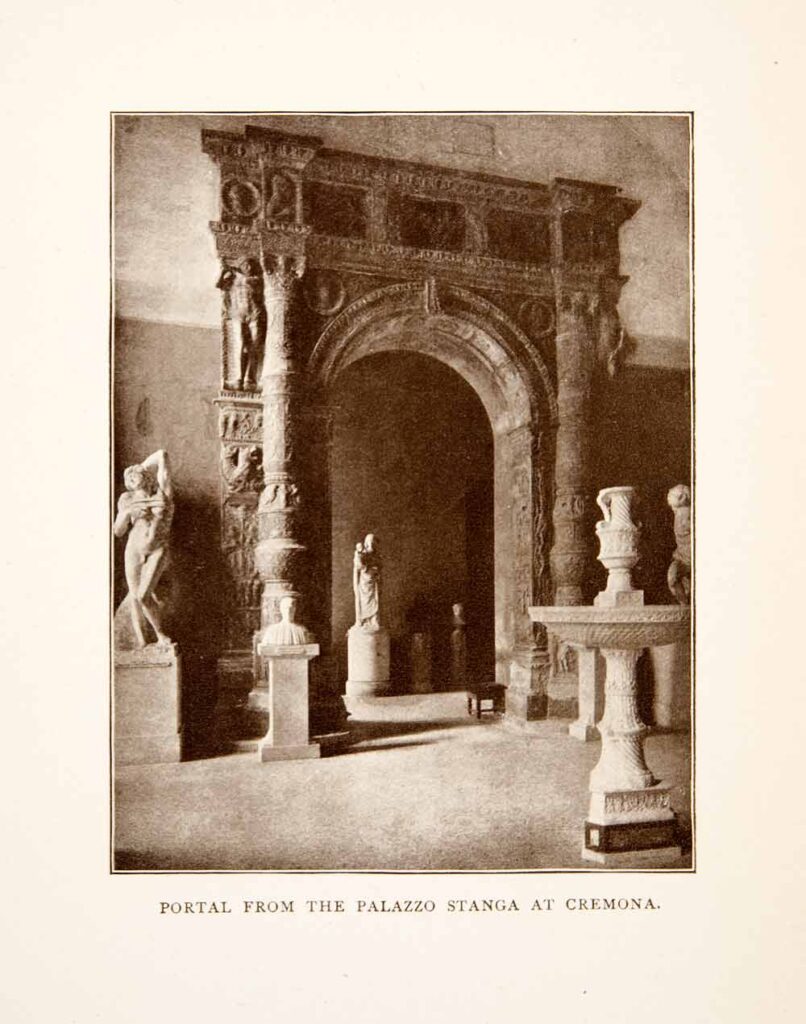
Serving as a scenographic backdrop in the Michelangelo Gallery at the Louvre stands a monumental portal, a splendid example of Lombard Renaissance sculpture. It originates from Palazzo Stanga, built in Cremona at the end of the fifteenth century for Cristoforo Stanga, Grand Knight, appointed by Gian Galeazzo Visconti as Lieutenant of the State of Milan, to which Cremona was politically subject at the time.
The palace underwent a first, radical transformation in the eighteenth century, when it passed to the Rossi family, who modernized it according to the prevailing Baroque taste, giving it the appearance the building still retains today. Further works were carried out in 1870, and it was during this phase that the ancient portal was dismantled, sold, and in 1875 acquired by the Louvre through the Marseille-based collector Édouard Vaïsse.
The portal is attributed to Pietro da Rho (Rho, ca. 1465 – after 1513), an artist active mainly in Cremona, where he worked on the decoration of numerous palaces and served the Fabbrica of the city’s cathedral, contributing to the upper part of the façade with the execution of several statues.
This portal is considered one of the masterpieces of Northern Italian Renaissance sculpture. Over seven meters high and shaped like a triumphal arch, it was conceived to celebrate the prestige of its patron through an exceptionally rich iconographic program inspired by classical antiquity. It was carved from blocks of Candoglia marble, the same material used for the construction of Milan Cathedral.
At an unspecified moment in the nineteenth century, however, the portal was covered with a dark brown layer of paint, later treated with wax applications.
These interventions were likely intended to protect the surface, but inevitably—even after an initial attempt at their removal—they severely compromised the legibility of the sculpture. Residues flattened the volumes and obscured details, prompting the museum to undertake this major restoration campaign.
As is always advisable before intervening on a work of art, a lengthy and articulated phase of preliminary study was carried out to precisely assess the condition of the marble and determine the most appropriate conservation methods. The investigations were coordinated by the C2RMF (Centre de recherche et de restauration des musées de France), which conducted the scientific analyses that identified the chemical nature of the dark layer to be removed, composed of oxalates. Numerous tests were carried out by the restorers to determine the most effective and least invasive approach.

The team responsible for the intervention proceeded to remove the dark layer using laser technology, complemented by a mild chemical treatment to eliminate the waxes, all in full respect of the original material. Once the nineteenth-century paint layer was removed, the marble revealed a subtle golden tonality. A more aggressive use of the laser could have reduced this effect further, but at the risk of damaging the original marble surface. The chosen approach successfully restored the quality of the reliefs, the modulation of volumes, and the clarity of profiles, draperies, and medallions, while also allowing the rediscovery of black stone inlays that accentuate and enrich the overall composition.

Thanks to this intervention, the Stanga Portal can once again be read in its full material and historical complexity, regaining a dignity that this masterpiece—despite having been on public display for over a century—had gradually lost along with part of its expressive power. Completing the project, a new lighting system was installed, enhancing the delicacy of the sculptures and the dialogue between solids and voids, while emphasizing the depth of the reliefs and the richness of the iconographic program.

Through this restoration, the Louvre returns to the public not only a conserved artwork, but an essential fragment of the artistic history of the Lombard Renaissance, once again legible in its authenticity and symbolic value.