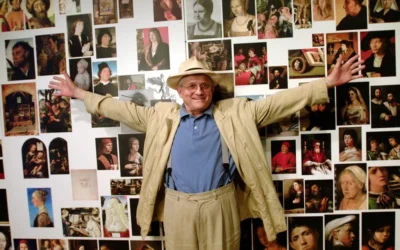
The former head of the Rembrandt Research Project, Ernst de Wetering, died on 11th August 2021.
He has been a crucial figure in the authentication arena, and a very powerful connoisseur. As chairman of the RRP from 1990 till the cease of activities in 2011, he contributed to process many Rembrandt’s attributions.
And now many of those may be challenged again, we suspect.
For about 50 years, it was not without the positive consensus of the RRP that a Rembrandt was a Rembrandt, unless it was .personally de Wetering to support or dismiss it.
Let’s see why.
The turning point into attributing Seventeen –Century Dutch and Flemish paintings was the infamous “Van Meegeren Scandal”, in 1945 -when“Christ and His Disciples at Emmaus” widely celebrated as one of Veermeer’s best paintings turned out to be a forgery.
In the trial, scientific analyses proved to be essential in assessing authenticity, while before it, it had been fairly common for well-known experts to state their opinion simply referring to their intuition, or “feeling”, about a painting, will little further explanation.
This was clearly no longer possible, after all the embarrassment caused by having supported a blatant fake.
Therefore, when in the sixties it was decided to produce a new Catalogue Raisonne of Rembrandts works, it was set out to combine traditional connoisseurship with the newest scientific techniques and form a board of expert to assess every single piece.
Dendrochronology proved to be very useful in dating oak panels Rembrandts used for his early work, to detect copies and sometimes also to prove that what had been considered to be a late imitation was made on authentic seventeenth century wood.
X-rays proved to be valuable in reconstructing Rembrandt’s working process, in terms of how he laid out his composition and the order in which he executed the various parts of a painting. Other peculiarities were to be discovered with the other techniques used, like UV photography and IR reflectography, together with chemical analysis of the materials used.
However, it was clear that in spite of usefulness of the various techniques, there could still be uncertainty about authorship, especially when distinguishing the master from talented pupils, having access to the same studio materials and techniques.
In some other cases, the uncertainty also derived from technical analyses that were not complete or of poor quality.
Hence the connoisseurship arbitration.
However, when the RRP concluded its activities, even though approximately one-quarter of Rembrandt’s oeuvre has not yet been investigated, no scholar wanted to assume responsibilities from the RRP’s chair.
What will happen now? Who will decide if a painting is a Rembrandt?
The most recent case where an attribution was proposed without the official blessing of the RPP, is the Portrait of a Young Woman Allentown from the Art Museum in Pennsylvania. It was in the twenties classified by the RRP as a product of Rembrandt’s studio rather than the master himself. In 2020 the experts from the museum claimed a different truth.
Elaine Mehalakes, the Allentown museum’s vice president of curatorial affairs, dared to state that the RRP had no modern technical means. The only technical image on which it relied was an X-radiograph from the late 1920s that, moreover, was taken when the panel was attached to a wooden cradle.
No objections from the RRP, as it did no longer exist, and probably because the signature discovered on the painting was a clear indication of authenticity.
We hope that new attribution/de-attribution will find on the available documents the best ground for reliable data interpretation. But let’s be honest: the race is open.
A good news is that the extensive documentation collected during the RRP is now mostly freely available online via the Rembrand Database project website, supported by several Museum and Art Institutions around the world.
“The Rembrandt database contains an extensive amount of various types of research documents, which are collected from all over the world and made online accessible for further research. This online guide aims to help users of the Rembrandt Database to navigate the bulk of the raw data. It also aims to provide insight into the information and documentation accessible in the database and to show how these research results have formed our image of Rembrandt as an artist”.
Let’s make the best out of it!