Diagnostic investigations are adding new insights into the technique of one of the most studied painters in the world. And this time, Vasari was exactly right.
After a full ten years, one of those restorations we can confidently call “historic” has concluded: the complete restoration of the Vatican Rooms (Stanze Vaticane), painted by Raphael and his disciples and assistants from 1508 to 1524—four years after the master’s death.

It wasn’t merely a conservation project, but a unique opportunity to study execution techniques and apply advanced diagnostic tools that have opened new perspectives on art history and Renaissance painting methods.
The scientific analyses were conducted by the Scientific Research Laboratory of the Vatican Museums. Its director, Fabio Morresi, stated that every single square centimeter of the paintings was examined. Cutting-edge techniques such as infrared reflectography, UV fluorescence, multispectral imaging, and targeted chemical analysis allowed researchers to look beneath the visible surface, revealing hidden details, unexpected materials, and otherwise invisible brushstrokes. Similar diagnostic and restoration campaigns could be launched in many other cases—with the assurance of exciting discoveries.
In this case, by studying the overlapping of the plaster layers, researchers reconstructed the exact timeline of individual workdays. Non-invasive ultraviolet light investigations made it possible to distinguish original parts from those added in subsequent restorations.
But the most important findings emerged from the cross-referencing of all data related to specific figures.
We know that Raphael was commissioned by Pope Leo X, between fall 1518 and spring 1519—at the peak of his twelve-year stay in Rome—to decorate the Aula Pontificum Superior, the hall used for banquets, ambassadorial receptions, and political audiences: the fourth and largest of the state rooms on the second floor of the Apostolic Palace.
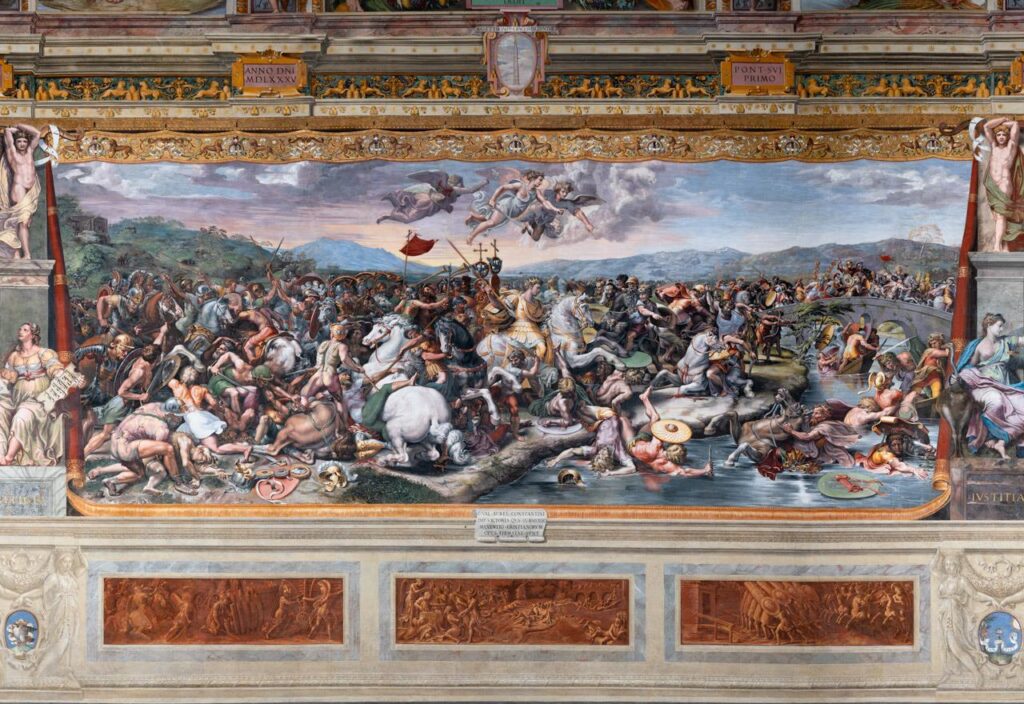
This room is of monumental size: 18 meters long, 12 meters wide, and about 13 meters high. The plan was to decorate each of the four walls with scenes resembling tapestries, depicting episodes from the life of Emperor Constantine, such as the Vision of the Cross, the Adlocutio, and the Battle of the Milvian Bridge. The goal was to visually express the transmission of auctoritas from classical Rome to Christian Rome. Unfortunately, in those final hectic months of his life, Raphael only had time to prepare the cartoons (preparatory drawings) for the frescoes before dying prematurely.
Vasari also gives us another interesting piece of information about the Room of Constantine, found in his biography of Giulio Romano. He writes that Raphael had the first wall of the room prepared to be painted in oil, but, due to disappointing results, his students decided to return to the traditional and more reliable technique of fresco painting.
One of the most striking results of this restoration and investigation campaign was the identification of two allegorical figures in the Room of Constantine—Comitas (friendliness) and Iustitia (justice)—positioned in the corner between the scenes of the Vision of the Cross and the Battle of the Milvian Bridge. These were not painted in fresco, unlike the others. In fact, it was discovered that the first was painted using the unusual technique of oil on wall, and the second using egg-tempera with oil (a “fat tempera”). This discovery was made possible thanks to the cross-referencing of stylistic data, historical sources, and scientific evidence.
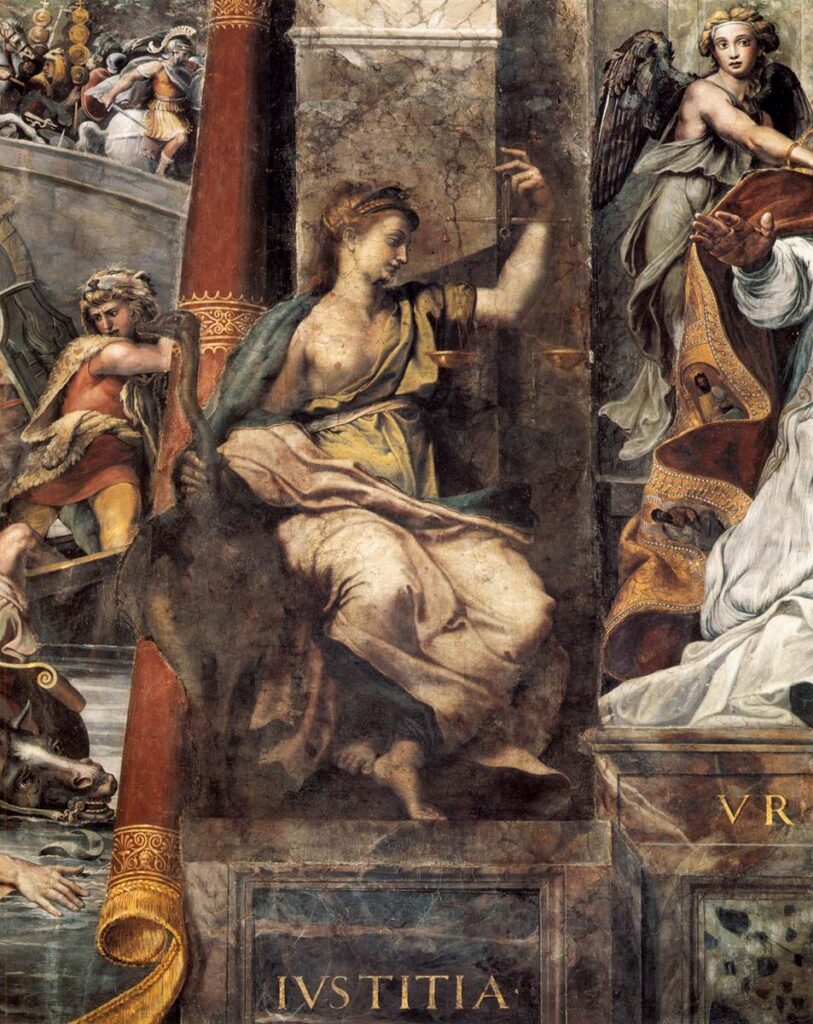
These could well be among the last works executed by Raphael before his death.
The analyses also revealed the presence of numerous nails beneath the paint layer, used to secure an intermediate support—heated colophony resin and a thin layer of white plaster—which likely enabled Raphael to paint in oil on wall while achieving the textured effect of panel painting. Moreover, the presence of nails over a large part of the wall confirms that Raphael intended to paint the entire room in oil. Undoubtedly, this is a fundamental discovery, revealing a previously unknown technique.
Director Barbara Jatta commented:
“Only thanks to this restoration can we now affirm with certainty that the two female figures are by Raphael’s own hand. More than a discovery, we can call it a rediscovery—through which Raphael’s greatness shines even more. In his refined approach, the painter, moving away from fresco, sought to equal the chromatic perfection of oil on panel, transferring its shimmering tonalities and vibrant colors onto the wall.”