A conference at the National Museum of Medieval and Modern Art of Arezzo revealed the extraordinary refinement of the techniques used by Margarito and his contemporaries
A major international project has brought together many of the most prestigious European and American institutions for one of the most extensive studies ever conducted on 13th-century Italian painting techniques, culminating in a three-day conference held from October 9 to 11.
Five years of multidisciplinary research have intertwined scientific analyses and archival investigations, offering a new understanding of the artistic practice of Margarito d’Arezzo — an artist regarded as pivotal in the transition from Byzantine painting to early Italian painting — as well as of the broader cultural context in which he worked.
The study explored the vibrant and diverse artistic production of the 13th century, a period that has been little studied but has revealed surprisingly refined and fascinating technical aspects. Among these are the masterful use of metal leaf to create a variety of effects, the use of lacquers or inclusions of glass and semi-precious stones — clear references to the heights reached by goldsmithing — as well as the compositional sophistication of details that over time had become invisible or extremely difficult to discern due to material degradation, now brought back to light through investigation and restoration.

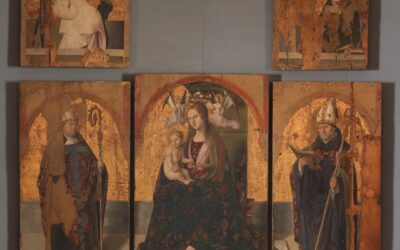
Everything began in 2020 with the restoration and technical study of the Virgin and Child Enthroned with Scenes of the Lives of Saints preserved at the National Gallery in London. The research soon involved the National Gallery of Art in Washington, which houses another work by Margarito, the Madonna and Child Enthroned with Four Saints. Scientific investigations carried out on the two paintings revealed hidden details and prompted American conservators to intervene on the work, uncovering sections that had been obscured by old overpainting.
The project then expanded to include the National Museum of Medieval and Modern Art of Arezzo and SUPSI (the University of Applied Sciences and Arts of Southern Switzerland), which conducted non-invasive investigations on the altarpiece of the Sanctuary of Le Vertighe. Thanks to European funding, in 2023 Italian and Swiss researchers worked together in London with experts from the National Gallery, paving the way for new analytical campaigns made possible by research infrastructures funded by the European Commission.
Meanwhile, the National Picture Gallery of Siena and the University of Siena began studies on the Saint Francis of Assisi kept in the museum, while the Superintendency of Siena, Grosseto, and Arezzo promoted research on the Madonna and Child of Santa Maria in Valle.
This significant project made it possible to share a vast amount of data on artworks that are not usually among the most studied.
The results of this extensive work have restored not only the complexity and modernity of Margarito’s art but also that of his contemporaries — artists capable of handling materials in ways never equaled again, such as using a leather preparation to achieve an enamel-like effect that has withstood the passage of time.
The publication of the conference proceedings will undoubtedly represent a milestone in the study of painting from this period. In the meantime, recordings of the conference have been made available online on the MNAMMA (National Museum of Medieval and Modern Art of Arezzo) YouTube channel.
Art-Test carried out investigations of the Saint Francis from the Siena Picture Gallery.