Hidden away in the storerooms of London’s Victoria and Albert Museum is a carpet that fooled historians, collectors, and curators for decades: the Chintamani
Measuring 2.97 meters long by 1.92 meters wide, made of wool and knotted with a symmetrical knot, the carpet was displayed for years in the prestigious London museum as an authentic masterpiece. It drew the admiration of enthusiasts and scholars alike, who were convinced they were in the presence of an object of extraordinary value.
The term Cintamani actually refers to the design: three circles arranged in a triangle, or three circles placed above one or two wavy lines. It represents an ancient symbol shared by Hinduism and Buddhism. The motif spread across Asia, from Tibet to Anatolia, and is universally known by the same Sanskrit name, meaning “three jewels” or “wish-fulfilling gems.” In some traditions, the circles also evoke the spots and stripes of great felines — always a symbol of supernatural power.

The Cintamani in question arrived at the Victoria and Albert Museum in 1933, brought by the Viennese dealer Paul Perlefter. Visiting the curator Cecil Tattersall in person, he convinced him it was a rare 16th-century Ottoman piece. Perlefter asked for around £8,000 — about a quarter of the museum’s annual acquisitions budget — and the V&A considered it an excellent deal. Both men’s wishes seemed to have been granted.
For three decades, the carpet was exhibited as an authentic Ottoman treasure, becoming one of the museum’s most admired and iconic pieces.
Doubts and scientific revelation
By the 1960s, suspicions about its authenticity began to surface. In 1962, George Wingfield Digby, a curator at the V&A, received a letter from the American art dealer and carpet specialist Nessim Cohen. Cohen claimed the Cintamani was a modern forgery, likely based on an insider tip.
His persistence prompted the museum to commission tests. Chemical and physical analyses soon confirmed the unthinkable: the red threads had been dyed with 19th-century synthetic pigments such as purpurin and chrysophenine, rather than traditional Ottoman dyes. The discovery led to the carpet’s immediate removal from display and its quiet transfer into storage.
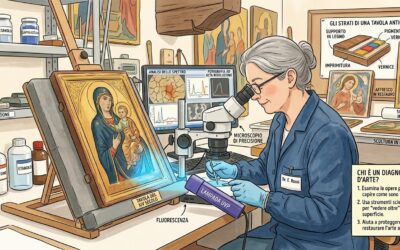
In this case, as with many others, scientific diagnostics proved decisive — an essential tool for distinguishing replicas from authentic historical artifacts. Only the combination of scholarly expertise and scientific analysis can safeguard collections, works of art, and investments.
Today, the Cintamani is classified as a copy made in Romania around 1920–1930. It remains in the V&A’s storerooms, accessible only by appointment. With hindsight, it is easy to wonder how the curator could have been deceived. But that judgment comes easily — once the science has spoken.