The issue of forgeries has always been a challenge in the art world. The production of fake artworks is not just about deceiving others and making easy money—it also has a significant impact on the cultural and economic value of authentic works.

Just recently, news broke of the seizure of over 70 counterfeit artworks in a workshop in Rome. The forger, a restorer, had created numerous paintings with forged signatures, spanning vastly different periods, including works falsely attributed to Picasso and Rembrandt. He used canvases that appeared antique, but his “original sin” was the use of anachronistic materials inconsistent with the painting techniques of the artists he sought to imitate. To support the provenance, he even applied fake stamps linked to collections and galleries no longer active in the art sector.

Unfortunately, this phenomenon is widespread: in an increasingly globalized market, counterfeits can easily slip in among authentic works, eroding the trust of collectors and art enthusiasts.
But when can an artwork truly be considered authentic? It is authentic when the study of its artistic technique and materials confirms that they correspond to the historical period it claims to belong to. Authentication is not secondary to attribution; in fact, attribution comes later and results from a much more complex study.

Authenticity is a fundamental requirement for any artwork, not only from an artistic perspective but also for legal and commercial reasons. Therefore, it is crucial to distinguish between an authentic piece, even if unattributed, and a counterfeit one. But how can this be done?
I sought to answer this question in my thesis for my Master’s degree in Diagnostics and Materials for Conservation and Restoration at the University of Florence, which I developed during my internship at Art-Test Florence.
The thesis, titled “How to Identify a Forgery. Understanding an Artwork: Intuition or Scientific Data?”, explores the fascinating phenomenon of art forgeries, analyzing methods of identification and the historical, cultural, and economic factors that have influenced their production.
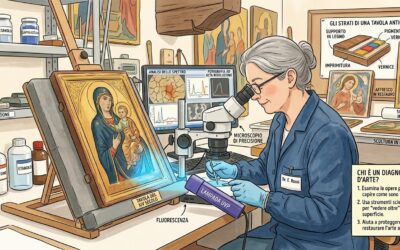
Every artwork is unique, so its authentication requires a tailored approach. However, this process must always follow a multidisciplinary method that combines science and expertise. In this context, diagnostics applied to Cultural Heritage plays a crucial role. Through both invasive and non-invasive investigative methodologies, it provides objective data that can be essential for authentication.

At the same time, for attribution purposes, the role of connoisseurship should not be underestimated. Through experience and keen observation, it contributes significantly to the evaluation of artworks.
The goal of my thesis was to highlight the importance of collaboration between science and the expertise of various professionals. Only by fostering a continuous dialogue between science, history, and art criticism can we continue to uncover the stories and truths hidden within artworks.
The completion of my thesis was made possible thanks to the expertise and support of Art-Test, where I had the opportunity to work on significant cases related to my research and to participate in diagnostic campaigns on important works of art. My experience at Art-Test was a great source of inspiration and professional growth, enriching my academic journey.
This joint effort led to excellent results: my thesis was awarded the highest grade and was positively evaluated for its innovative approach to a topic that had never before been explored in the Diagnostics for Cultural Heritage program at the University of Florence.